photo 427557833905665036_zps1423272d.gif
Showing posts with label Local Music Gear. Show all posts

Tuesday, August 11, 2015

Building a Custom Guitar From Start to Finish, Part 1: Getting started ...

Written By: Jac Harrison
At least once a month I get an inbox on social media or an email asking questions about getting a custom guitar built and all the bla bla bla that goes with it... so for the next few months I will be documenting a build from start-to-finish covering every aspect from how to choose a luthier (guitar builder), choosing a design that works best for you, how to not "over spend" and there will be video of the actual build from the luthier in part two of this series. On that note, this will be in a three part editorial series called "Building a Custom Guitar From Start to Finish", and will be in direct correlation with the Facebook group "Beardly Customs Build for LMG". The luthier I will be working with is Rick Link of Beardly Customs and he has agreed to do this build as an interactive workshop allowing you (the reader) to follow the step-by-step process of ordering a custom built guitar, and watching it built in real time while he answers questions in regards via the Facebook group. By the end of this editorial series you should have a complete understanding on how to spend a few thousand dollars on a custom built guitar while feeling fuc*ing amazing about it! Now let's get this party started...

Wednesday, January 21, 2015

Price -vs- Value When Buying A Budget Guitar ....

Local Music Gear Feature Story 
Written By: Jac Harrison
Recently, I have noticed an influx of new guitar players on social media in the groups and pages I manage, and few of others that I’m a spectator in. Everyone seems so eager to learn about buying their first guitar or are looking for advice on buying a guitar on a budget. To me, it is exciting to see so many new faces playing what I consider the best musical instrument, but at the same time I feel bad for the novice today due to the over abundance of misleading information in regards to price-vs-value because of the fuc*ing know-it-alls on the interwebs. Thirty plus years ago when my father gave me my first guitar, he didn’t ask 40,000 people (that he never met) what they thought would be the best guitar for a beginner. We took a trip to Hi - Way Music on rt 18 in East Brunswick, NJ where I was given the choice of the ugly one I played with humbuckers or the ugly one I played with single-coils (I went with the buckers). Knowing that not everyone has access to someone that can explain to them what to look for like my father did for me, this month's editorial will be based on the some of knowledge I have gained while buying, selling and trading guitars over the last 20 years. So for all the social media know-it-all as*hats and the keyboard wizards of knowledge, please stop reading this and go Google something so you can continue your "awesomeness". This is meant for the guitarist that wants to learn buying techniques that will allow he/she to make an educated decision at the point of sale to obtain the highest quality guitar on a budget.

Sunday, May 25, 2014

Classic Vintage vs Modern Vintage Guitar Pickup Technology ...

Local Music Gear Feature Story 
Written By: Jac Harrison
Vintage reproduction, vintage vibe, classic tone, and antiquity are just a few of the names that guitar pickup manufacturers use to describe the tone of their product(s) so we (the guitarist) associate them a particular time era. Some manufacturers will even go as far as to classify a pickup's voice with a year and/or a particular artist name that had a desirable tone from that time period. These are all wonderful marketing techniques that are designed to make us (the tone chasers) open our wallets and say “yes please, I may need that". This is great if you want a particular tone but do not fully understand how to achieve it, but for the rest of us it is an indication of future disappointment 90% of the time. When I see a manufacturer selling a vintage/classic style pickup, I take it as their way of saying that the product has a certain dynamic response that reacts to the players touch opposed to a modern style pickup that has compressed feel, and less about the overall tone. Anyone can Google the specs for a vintage pickup, buy the raw materials and make one -- but it takes talent to voice the pickup giving it that dynamic response we associate with vintage guitars (pre-1980). As a vintage/classic tone style pickup player, one of things I always focus on when selecting a pickup is what I am trying to achieve tonally and less about what year do I want to sound like. If I was replacing pickups in a 1964 Start or a 2014 Chili Custom Guitar, I would want the same in both guitars -- a tone that is unique to me that is built on a platform that allows me to control my tone with dynamic response.

Thursday, April 10, 2014

Chasing That Vintage Tone on a Working Musicians Budget...

Local Music Gear Feature Story 
Written By: Jac Harrison
Since the beginning of time, mankind has been trying to replicate "stuff" that we have observed to enhance our lives making it more enjoyable. "Stuff" like harnessing the power of fire to cook our food to insure that it is safe to eat, using river-rock and gravity to purify our drinking water to prevent bacterial infection, and in this case -- the most important of all, making your guitar have that vintage mojo to achieve the tone of the gods (I got choked up just saying that).

About ten months ago I had this crazy idea that I could put together a guitar that had the same characteristics of a traditional 1954 Les Paul, but with a few modern amenities that I have become accustomed to. My goal was to make this guitar a usable instrument and not a watered down novelty like the "reissues" that flood the market place today. Originally; I commissioned a NY based luthier to build a guitar to my specifications, but he turned out to be difficult to work with, so I used a guitar that I already had in my personal collection that was 95% of what I was going for with the commissioned  build.  The only real difference between the donor guitar and the commissioned build was that the commissioned build was a five piece neck through body (a modern amenity that I would have enjoyed) and the donor is a set neck, like the original had in 1954. With that said, this is my step-by-step "manifesto" on how I turned my 2012 Jarrett Zaffiro in to a 1954 Les Paul tone clone ....

Tuesday, December 3, 2013

Boutique Tone On a Budget, 2005 Epiphone Valve JR hot rod mods...

Local Music Gear Feature Story 
Written By: Jac Harrison 
Some of us gearheads are more sensible when it comes to the amount of cold hard cash we are willing to part with when buying new gear. Some of us are even willing to deal with an amp that has less than desirable tone qualitys to save a buck (yuck). I get it, cash is king and our hobbies take the backseat to the essentials such as the mortgage/rent, bills and food. This is something that the larger musical equipment manufacturers take advantage of. Think about it... do you really think that a 100-watt 2x12 that retails for $330 USD is a quality amplifier? The answer is eff no! Some companies slap their badge on a solid state "amp" that probably costs them $50 USD to make (if that), and then they put it into a chassis that looks like one of their higher dollar products so the consumer (that's you) feels like they got a "hell-of-a-deal". First off, who really needs 100-watts of power? That's simple, not you and not me. As a gigging musician I can honestly say that I have never owned a 100-watt amp and I have played outdoor shows that had 3,500 + people attending while using an 18-watt amp. There is this new technology called "microphone". The way this "microphone" works, is a person known as a "sound guy" puts it in front of your amp's speaker so the sound of your amp goes through a PA system... to make it louder. A 100-watt amp will make your stage volume deafening, and you will not be able to get that sweet tube saturation that we all love at the a tolerable stage volume, causing your band to breakup and/or go deaf. Hell; I'm using a 50-watt amp now that I only turn up to (3), and my bass player needs to wear earplugs. For the hobbyist playing small venues, an all tube 5-watt to 18-watt amp (depending on the venue size) is all you really need. If the amp is voiced correctly -- you can achieve the tone of your dreams at any volume. 

Monday, October 7, 2013

Making Your Vintage Amp Better Than New...

Local Music Gear Feature Story 
Written By: Jac Harrison
I have been told by more than one person that I am nuts, crazy even disturbed when it comes to my passion/OCD for tone. Some guys can go their entire life chasing a sound and never get it just right -- but I'm one of those lucky SOB's that knows the tone my soul desires, and more importantly --  how to achieve it. Growing up in a musical household I had a jump start on refining my palate by using and abusing my fathers guitars and amps for many years, on a side note... sorry dad. After destroying a few guitars by "trying something new" -- I had found that a (2) humbucker setup is what I'm all about, but when it came to my amps I had been all over the map until a few years ago. When I was younger (and knew everything) I was a full stack, dark el84 with many digital effects player -- but after countless shows and studio hours I found that a simple and clean foundation is what I needed to achieve my golden tone. I wanted an amp that was touch sensitive with a clean but warm high end that I was able to control the breakup/tube saturation by using my guitars volume knob and/or a class A boost opposed to an OD pedal. I spent the better part of a year playing every amp I could plug into and came up with my "formula". Turns out that I am either what I call a simple 6L6/6V6 (an amp with very little controls) or an el84 player if the amp has a presents knob/bright switch and mid shift. With my new found knowledge I went out and picked up a Fender Supersonic 22 and I enjoyed her until she picked up a really bad smoking habit, so we went our separate ways a little over a year ago. Heart broken, I went out and found an amp that I loved form day one -- a Bogner Alchemist 2x12. This amp had a lot going for it except one thing, Line 6 customer service. The Bogner was suppose to be the amp in this rebuild story and it was going to focus on how to get your amp studio ready, but when I called Bogner to get a schematic they told me to contact Line 6 -- and after two weeks of bullshit from Line 6 I decided to go in another direction with this rebuild.

Tuesday, September 3, 2013

Small Amp, Big Tone, Small Budget --

Local Music Gear Feature Story 
Written By: Jac Harrison
Recently it has come to my attention that I am no “spring chicken” anymore, and I'm starting to look at my gear differently.  A few years ago I wouldn't have thought twice about the weight of my gear when buying an amp, but after lugging around my Bogner Alchemist 2x12 for the last 6 months, it has crossed my mind more than twice. One of the things I have always took pride in as a guitarist is my tone -- it is my signature. I have spent countless hours dialing in what I believe to be the best possible setup for each of my guitars to maximize and showcase their unique tonal personalities. For me to even think that I would consider buying an amp based on it's portability made me cringe -- but at the same time needing to visit the chiropractor after a rehearsal kind of changed my mind. Now I was not going to settle for some wimpy amp that was portable, I wanted a kick ass amp that was dripping with tone -- that just happened to be portable. I deiced that I was going to get an amp head vs a combo and then build an extension cab around it. One of the may qualities I enjoy about my Bogner is her versatility. I can get from a clean silver-face, to a crunchy tweed on channel one and vintage British to 80's hair metal on channel two -- so it was very important that found an amp that would give me similar tones.

Tuesday, August 27, 2013

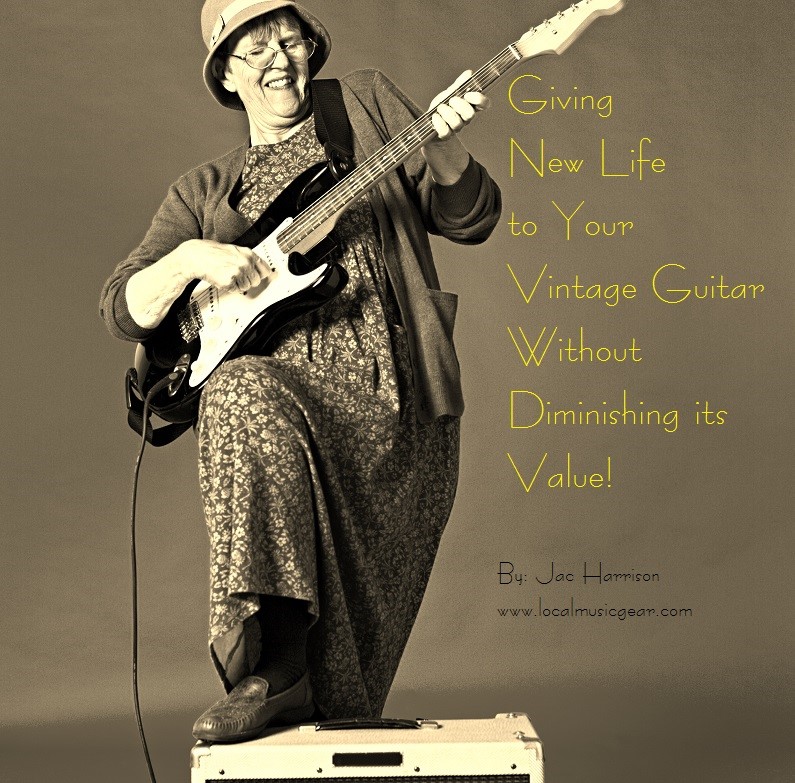
Giving New Life to Your Vintage Guitar Without Diminishing its Value.

Local Music Gear Feature Story 
Written By: Jac Harrison
Guitarist... we are a strange bunch. We search high and low to find a guitar that we fall-in-love with, and then after a few weeks we decide that the guitar that we couldn't live without a few weeks back, is not the best. Kinda sounds like every relationship I have ever been in, but unlike a woman you can modify the guitar to your liking legally. Now there are many ways to "hot rod" your guitar, from pickups and electronics to hardware and accessories  -- but when "hot rodding" a vintage guitar there are a few things you want to keep in-mind. To start, I like to stay away from all permanent installation products that modify the original design. If the mod requires a drill, saw or glue just don't do it -- go buy a new guitar.Your vintage guitar is an old lady, so she is suppose to look like and sound like she has some age on her. Some mods are like giving your grandmother a face lift and a boob job -- so ask yourself, who wants a hot grandmother? I don't, my grandmother looks and sounds like a grandmother, like she is supposed to. Now with that in mind, you also want to make sure that your vintage guitar is in full working order before you start your mods.

Monday, July 8, 2013

The Guitar Snob, Understating what you are buying is a good thing...

Local Music Gear Feature Story 
Written By: Jac Harrison

Recently I was called a "guitar snob" on a social network and at first I took offence to it, but then I really thought about it and I have to agree. Here are my thought on it --

In my twenties I knew everything -- but now at the ripe old age of thirty-four I have realized that I know very little in the grand scheme of things, but what I do know I understand completely or find out about by research. As a self-proclaimed guitarist with over 25 years of experience, I would like to think that I have developed a refined palate and consider myself knowledgeable when it comes to understating guitars and related musical equipment. With my "refined palate" I have also developed a taste for quality gear much like a wine snob has to wine. Now that word "snob" -- it is a label that most guitarist do not want to be associated with, who would? The definition of the word is less than flattering. According to the Bing Dictionary there are two ways to use this word to describe a person : (1) somebody who looks down on others: an admirer and cultivator of people with high social status who disdains those considered inferior (2) somebody who feels superior: somebody who disdains people considered to have inferior knowledge or tastes. But when the word "snob" is used to descried a person in relation to a particular product or hobby, I believe that it takes on a different meaning. For example; I enjoy a good bottle of wine with breakfast just like the next guy, but there is no way I would know what to look for when buying a bottle out of the novices price point. I would want an expert with an unbiased opinion to coach me through the different types of wine, explaining what makes them different from each other and most importantly what I should be paying for them based on their quality, like a "wine snob" would. So why not the same in the music world? 

Tuesday, June 11, 2013

The Local Music Gear 2013 NY Amp Show Wrap Up ...

Local Music Gear Feature Story 
Written By: 
Jac Harrison
June 1st & 2nd 2013 - The annual NY Amp Show took place in beautiful downtown Piscatawy NJ. Like always, Loni and his team put on a hell of a show. Now before I really dig deep into this year’s show there are a few points I want to touch on. To start -- this is my personal favorite show. I know that is a bold statement, but as a guitarist there is no better place that I have found to date where you can really play the gear -- and hear it. I attend everything from industry trade shows such as NAMM, to open floor small regional consumer tabletop shows and they all have one thing in common -- the noise police. There is nothing that pisses me off more at a guitar/amp show than having someone come by to tell me to turn it down. How the hell are you suppose to demo your gear as a manufacturer and more importantly play the gear as a consumer if someone is coming by with a meter to "protect your hearing". If I wanted to hear someone tell me to "turn-it-down", I would go to my mothers house. Now I get the fact that the organizers of the shows are legally obligated to protect the consumers hearing -- but come on -- get creative with your show layout and design. When I pay $20 to get into a show, I'm looking to buy gear and I want to hear it at stage volume or there will be no sale. This is why I love the Amp Show -- there is no noise police! Each manufacturer has their own hotel room that is staged as a mini showroom. You can play as loud as you want and for as long as you want -- you can even close the door for a private meeting. If you are professional musician or retailer, you can talk business in private. These are things that you just cannot do at a traditional tabletop or open floor plan guitar/amp shows. So to sum it up -- you can play loud and for a long time without being bothered by the noise police -- and you can talk in private with the manufacturer . That is why I love the NY Amp Show!

Tuesday, April 30, 2013

The Local Music Gear 2013 PAF Style Humbucker Comparison Review...

Local Music Gear Feature Story 
Written By: 
Jac Harrison
Confusion and frustration are emotions that come to mind when trying to describe the tone/voice we want from our guitar to the person making and/or selling us the upgrades to achieve that "holy tone" we dream of. There are so many variables that go into this equation that you can really hurt you brain just by thinking about it -- and even worst your pockets. The most common way to dramatically change your guitars tone/voice is by installing a new set of pickups. There are a few steps in the process of deciding what style of pickup you want based on your desired tone. To start you need to understand what the different pickup types do to your tone since you are no longer bound to the style of pickup that your guitar is setup for. Most pickup manufacturers are producing an interchangeable product for all platforms in any configuration. So what that means is -- if you have a single coil style guitar you can use humbuckers and vica versa. This opens up a whole new world of different tones you can achieve from one guitar -- but at the same time can be confusing.

Friday, March 22, 2013

The Five Best Guitar Picks Ever Made ...

Most of us self-proclaimed guitarist spend thousands of dollars and countless hours carefully hand selecting our gear to find our perfect tone. To me, my tone is more than just the sound that comes out of my amp -- but it is my signature and is the feeling of my sound. One of the elements I had over looked for many years was the guitar pick. About a year ago Graphtech had sent me their new guitar picks made of a material they call Tusq. I had used Tusq nuts and saddles on many of my guitars and knew what it did for my tone, but I wasn’t sold on the pick idea as I was used to playing with a Dunlop Tortex .88mm pick and never put much thought into it. To say the least, I was very wrong. The Tusq pick opened my eyes and ears to the idea that I could change/color my tone by using different guitar picks made from different materials. Over the last year I have been on a mission to find the perfect guitar pick and to my surprise there wasn't just one -- there where a few depending on what I was looking to achieve. This is a comparison of the five best guitar picks I found and what they did for my tone and playability. 

**I used a Dunlop Tortex .88mm as the control for comparison. 

Sunday, January 20, 2013

POS Re-Build, Tackling a Fender Squier Strat Bullet for a good cause ...

Once a quarter Local Music Gear has a POS (Piece of Shit) rebuild. This is when we take the most God-awful, poor excuse of an instrument and give it new life. We do this to show our readers that cannot, or will not, spend big bucks on an instrument how to make one that rocks within their budget. 

For this POS rebuild we did not have to go out and purchase a guitar. We had the pleasure of rebuilding one for a woman that is a little down on her luck due to ongoing health problems. Good for us her guitar was a Fender Squire Bullet Strat and that happens to be one of the biggest pieces of shit guitars I've ever seen --making it a perfect candidate for this series. 

So to me this was a no-brainer. We get a donor guitar for the editorial series -- and she gets it back with some serious modifications making it a playable instrument.

Friday, January 4, 2013

Local Music Gear's Best Products of 2012 ...


Over the last year we have had the pleasure of trying hundreds of exciting products that make playing guitar more enjoyable. While some products were good, others where just amazing. Every month Local Music Gear selects one of these amazing product to be showcased as the product of the month. For a product to become the product of the month it must exceed our expectations on three levels of standards.

Monday, December 17, 2012

Feature Story: Knowing The Difference Between Buying A Custom vs Boutique Guitar ...

Local Music Gear Feature Story 
Written By:
Jac Harrison
Many people overuse the words custom and boutique when describing their guitar, and for the most part they have no idea what it means. Just because it says custom or boutique on the head stock doesn't mean that it is. For example, some guitar manufacturers will call an entire line boutique, or a standard model a "custom/custom shop" to attract a buyer without the hefty price tag that comes with a true custom or boutique guitar. This doesn't mean that they aren't great guitars -- just that they are not what they claim to be. It is the same concept that the word artisan is to the food industry. If you believe that there is a dude with a handlebar mustache singing songs from the old country in the back of your grocery store while making a special batch of bread just for you...can I sell you a bridge?

Thursday, November 15, 2012

My Fretless Strat, Just Because I could ...

Local Music Gear Feature Story 
Written By: 
Jac Harrison

Earlier this month I had the chance to see Guns n Roses, in my opinion one of the greatest bands of all time, perform in sin city. The show was amazing and full of great music. As a guitar nut I was more interested in the guitars that the guys where using than the half naked dancers on stage. One of the guitars that blew my mind was a double neck Vigier guitar that Ron “Bumblefoot” Thal was using. This guitar was sick; it had a standard fretted neck on the bottom and a fretless on top. Knowing that I would be in Philly for the Bee 3 vintage guitar show in just a few days and that Vigier Guitar would have a booth there I decided I needed to try one of their fretless guitars.

At the Bee 3 show DJ Scully, from Vigier Guitars, let me play the fretless for about an hour and I knew I needed to have it. But with a price tag of $3,300 I also knew that it was not going to happen right now. Since fretless is a unique beast I wanted to learn how to play it as well as a fretted guitar before I put down that kind of cash. I did a little research online and called Fred, (the head luthier at WD Music Products) to get his advice on how I could make my own. To my surprise it was very simple. I needed to remove the frets, backfill the gaps and sand with a radius block.

Monday, August 20, 2012

Three Great Ways You Can Get That “Dream Guitar” Without The Hefty Price Tag, A fun project for the do it yourselfer…


Local Music Gear Feature Story
Written By:
Jac Harrison
Many of us self-proclaimed guitarists are always on the search for that perfect guitar. We know what we are looking for -- but we just can never seem to find it. When we find a guitar that has the look we want it doesn't have the right sound and vice versa.

There are many luthiers, custom, and boutique shops that can make a guitar to your specifications -- and that's great if you have the cash. For a well built guitar you can expect to throw down around $1,500 or more. For those of us that just can not or will not pay that much for a guitar there are a few alternatives that can get you that perfect axe you have dreamed of.

Thursday, August 16, 2012

Local Music Gear Magazine Solo Search Event Show Recap, & the winners are ...

Local Music Gear Event Coverage
Written By:
 Dan O'Donnell
On August 11, more than two dozen aspiring guitarists showed up at the first ever Local Music Gear Magazine acoustic guitarist SoLo Search, hoping to win more than $2,000 in prizes from the event sponsors that included Fishman, Seymour Duncan Pickups, Cleartone Strings, LuteHole Soundhole Covers, and Graphtech, among others including Supreme Sound Studios, of Woodland, NJ, who awarded recording sessions to the winner, and runner-up. 

Sunday, July 29, 2012

Feature Story: Paving The Way To Your Dream of Becoming A Rock Star, Step Three - Upgrading Your Guitar ...

Local Music Gear Feature Story
Written By: 
Jac Harrison
Congrats - you have done it! You bought a guitar and learned how to play. Now that you are playing for longer periods of time and have a slew of material learned you may realize that your dream guitar isn't so dreamy anymore. You have entered into what I like to call the "going broke" phase of this hobby. As you've refined your playing, you have developed the ability to hear the slight differences in the sound of your guitar that a non-guitar player can't hear and will think you're nuts for noticing. Now before you get all upset and look for a new guitar, just know that there are a few simple things you can do to make the same old guitar dreamy again.